


 English
 German
 French
 Italian
 Spanish
 Portuguese
 Chinese
 Lithuanian
3.1.4 Nevus Flammeus
ICD-11
LC50.1
Synonyms
Nevus vinosus, Portwine nevus, Naevus teleangiectaticus.
Epidemiology
0.3-1% of the population; F 2x M.
Read more
Naevus flammeus is frequent. It affects 0.3-1% of the population, with women being twice as likely to be affected as men. Cases are usually sporadic, but a 10% familial incidence and an autosomal dominant inheritance have been described.
Definition
Benign vascular malformation since birth. Sharply demarcated red spots, due to dilatation and augmentation of small superficial vessels in the affected area.
Read more
Nevus flammeus is a sharply circumscribed red to bluish (port-wine coloured) patch present since birth. This is a benign vascular malformation consisting of increased numbers of dilated dermal vessels.
Aetiology & Pathogenesis
Inherited. May be in the nosologic context of angiodysplasia syndromes (Sturge-Weber-Syndrom, von Hippel-Lindau-syndrome, Klippel-Trénaunay / Parkes-Weber-syndrome).
Read more
This is a benign skin condition, present since birth.
It is rarely associated with genetic angiodysplastic syndromes (Sturge-Weber syndrome (encephalotrigeminal angiomatosis) associated with GNAQ mutations, or Klippel-Trénaunay syndrome associated with PIK3CA mutations).
Signs & Symptoms
Sharply demarcated red spots and patches without augmentation of tissue.
Read more
Lesions are sharply circumscribed red or violaceus macules or patches without palpable features. In rare, unilateral cases, papules or nodules may appear over time.
Localisation
Axial nevi flammei: (Unna-nevus; angel’s kiss of the forehead; Salmon Patch); never associated with syndromatic angidystrophy.
Lateral nevi flammei, syndrome associated quadrant nevus
Trigeminus-area: unilateral Portwine-nevus; potential association with meningeal or central nervous angiomas of eyes, meninges and brain (Sturge Weber syndrome)
Extremities: possible association with venous malformation and increased growth of soft tissue and bones of the respective limb (Klippel-Trénaunay syndrome).
Classification
True nevoid not self-regressing capillary malformations
Temporary and regressing capillary malformation «Salmon Patches» (neck, forehead)
Read more
Nevus flammeus comprise capillary malformations representing real naevi, and capillary malformations that do not represent nevi, such as the frequent median and regressive lesions now called salmon patches.
Laboratory & other workups
None. Ultrasound for the determination of depth.
Dermatopathology
Not needed. Dilated vessels in the dermis.
Course
In contrast to axial nevi, the lateral nevi do not regress spontaneously, but enlarge with body growth, change color to deep red, and can show tuberous transformation (i.e., macrocheily) and pyogenic granuloma.
Read more
Axial lesions tend to regress spontaneously but may not disappear completely. Lateral ones grow with body growth, get darker with age and may develop nodular changes (e.g. soft tissue enlargement of lips) and pyogenic granulomas.
Complications
Exclude involvement of eye (glaucoma) in periorbital nevus flammeus. Additional complications may be found in conjunction with angiodysplastic syndromes (CNS-involvement; hemorrhage; thromboses; limb deformities).
Read more
In periorbital nevi flammei ocular involvement (glaucoma, which can lead to blindness) should be excluded by an ophthalmologist, and brain magnetic resonance imaging (MRI) should be performed to exclude meningeal or central nervous system angioma (Sturge-Weber syndrome), which can be complicated with seizures, stroke, or mental retardation.
Klippel-Trénaunay syndrome may be associated with complications (bleeding, thrombosis, soft tissue deformities).
Diagnosis
Typical clinical features.
Differential Diagnosis
Infantile hemangioma: red-blue vascular tumor (not nevus!), developing in the first week of life, grows proportionally and regresses spontaneously after months.
Prevention & Therapy
Laser, intense pulse light, cosmetic camouflage.
Ophthalmologic control for nevi covered by trigeminus I and II.
Read more
Nevus flammeus may spontaneously disappear in the first 6 months of life (especially the stork bite and angel’s kiss types). A treatment is generally not needed and only indicated in cosmetically or functionally severe cases. Cosmetic camouflage, laser treatment, intense pulsed light, may be used.
Special
None.
Diagnostic algorithm
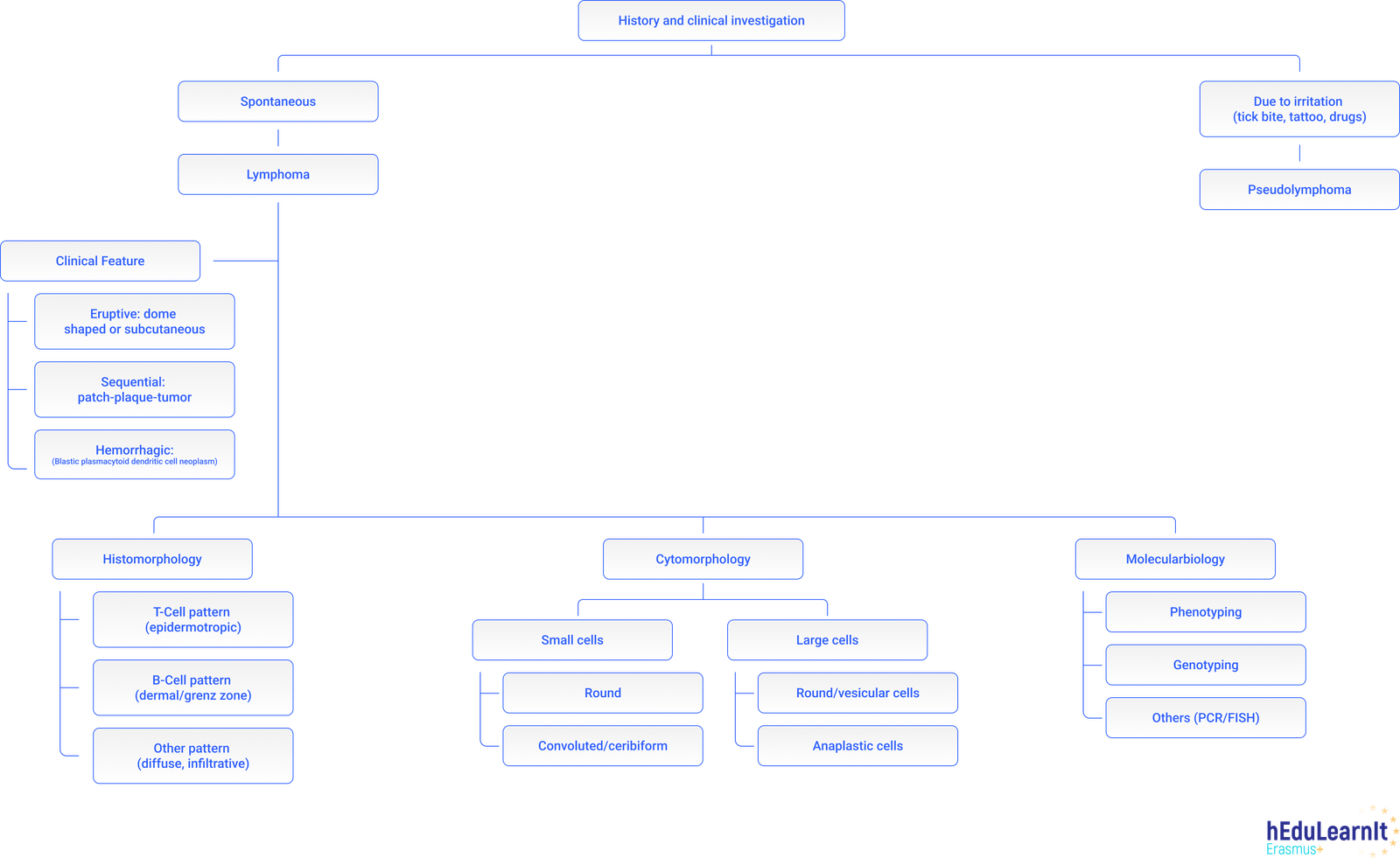

Differential Diagnosis


Podcasts

Tests
- Nevus flammeus can change their intensity of color
- Aussage 1 Teleangiectasias are usually acquired
- Statement 1: Nevus flammeus are already present at birth,
- Hemangiomas generally do not require treatment
- Nevus flammeus is usally a harmless skin lesion
- Statement 1 Nevus flammeus can change their intensity of color
- Statement 1 Nevus flammeus can pose considerable cosmetic problems
- Statement 1 A nevus flammeus can be identified with the naked eye
- Statement 1 Telangiectases are usually acquired
- Statement 1 A nevus flammeus is a malformation
- Statement 1 Nevus flammeus is present at birth
- Statement 1 Hemangiomas generally do not require treatment
- Statement 1 Nevus flammeus is a common and usually harmless lesion
- One of the most common malformations?

Further images / DOIA
References
This website uses cookies!

We use cookies to tailor our content to your needs and continuously improve our website. You can decide which cookies you want to allow. Detailed information about the cookies we use can be found in our Privacy Policy and Cookie Settings. You can withdraw your consent at any time.

Comments
Be the first one to leave a comment